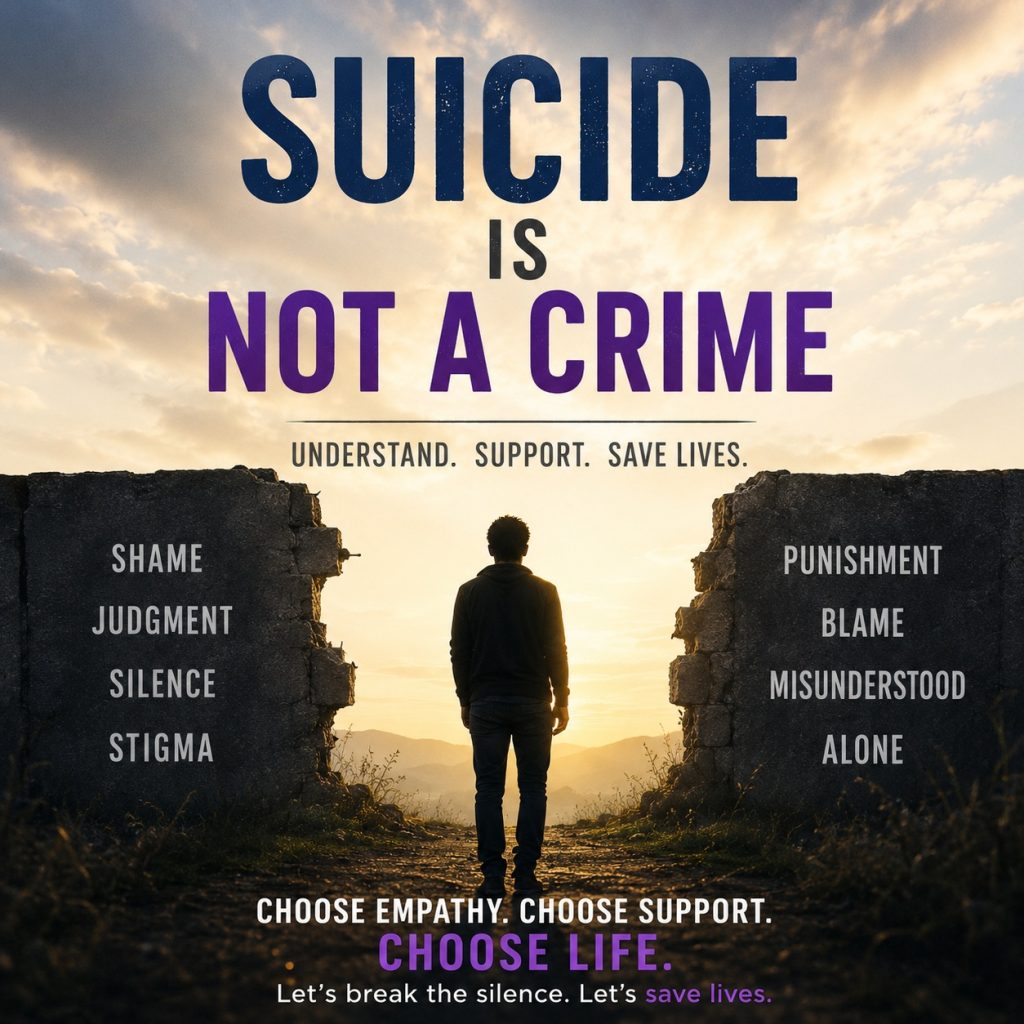

Suicide is not a crime, it is a cry that went ignored for way too long. It’s not “selfish” or weakness, it’s often exhaustion, frustration, chronic anxiety, depression, financial burdens, shame, grief, and majorly, lack of support systems. People don’t take their lives because they want to die, but because they can’t see how to keep living, convinced that rest, through death, is the only relief left. People die by suicide not because they wanted to, but because they ran out of reasons to stay. The law calls it a crime. The heart calls it exhaustion.
A few months ago, I watched a video that hasn’t left me. A truck was parked by the roadside, and a young man laid himself under its tyres, hoping that once it started moving, it would step on him. His clothes were torn and dirty, he clearly wasn’t okay. People screamed, a crowd gathered, someone called the police.
I expected the officers to talk to him, calm him down. Instead, two officers intervened by beating and arresting him, right there in front of everyone who had watched him try to end his life.
That is what we do to people in Uganda when they survive their darkest moment. We arrest the exhaustion, handcuff the hopelessness, and call it justice. Under Section 210 of Uganda’s Penal Code Act, attempting suicide is still a criminal offence, punishable by up to two years in prison. A cell, not care.
Suicide cases in Uganda rose sharply between 2023 and 2024, and men are dying at nearly five times the rate of women. Part of this is culture — we raise our men to swallow pain silently, and treat mental struggle as a shame to hide rather than a health issue to address. So people suffer quietly until it’s a crisis, and then we punish them for it. Criminalization doesn’t stop the struggling; it only stops people from telling anyone before it’s too late, teaching families to hide, survivors to lie, and communities to stay quiet instead of showing up for one another.
We laugh at people mid-breakdown, gossip about the “mad” ones, jail the broken and call it accountability, then ask why nobody speaks up. You cannot arrest someone out of hopelessness. You can only add to it.
What we need is not more prisons for pain, exhaustion and frustration — it’s more people who listen. We need police trained to treat a suicide attempt as a medical emergency, not a crime scene. We need hospitals and community centers offering real psychosocial support, not judgment. We need a culture where reaching out isn’t met with mockery.
Decriminalizing attempted suicide won’t fix everything, but it’s the first honest step toward telling every Ugandan quietly drowning in exhaustion: your life matters more than your worst moment. You are not a criminal, you are someone who needs to be heard.
Alexis Ssekabembe
Executive Director, Vital Minds Initiative (VMI) Uganda
“Grow Minds, Grow Futures”